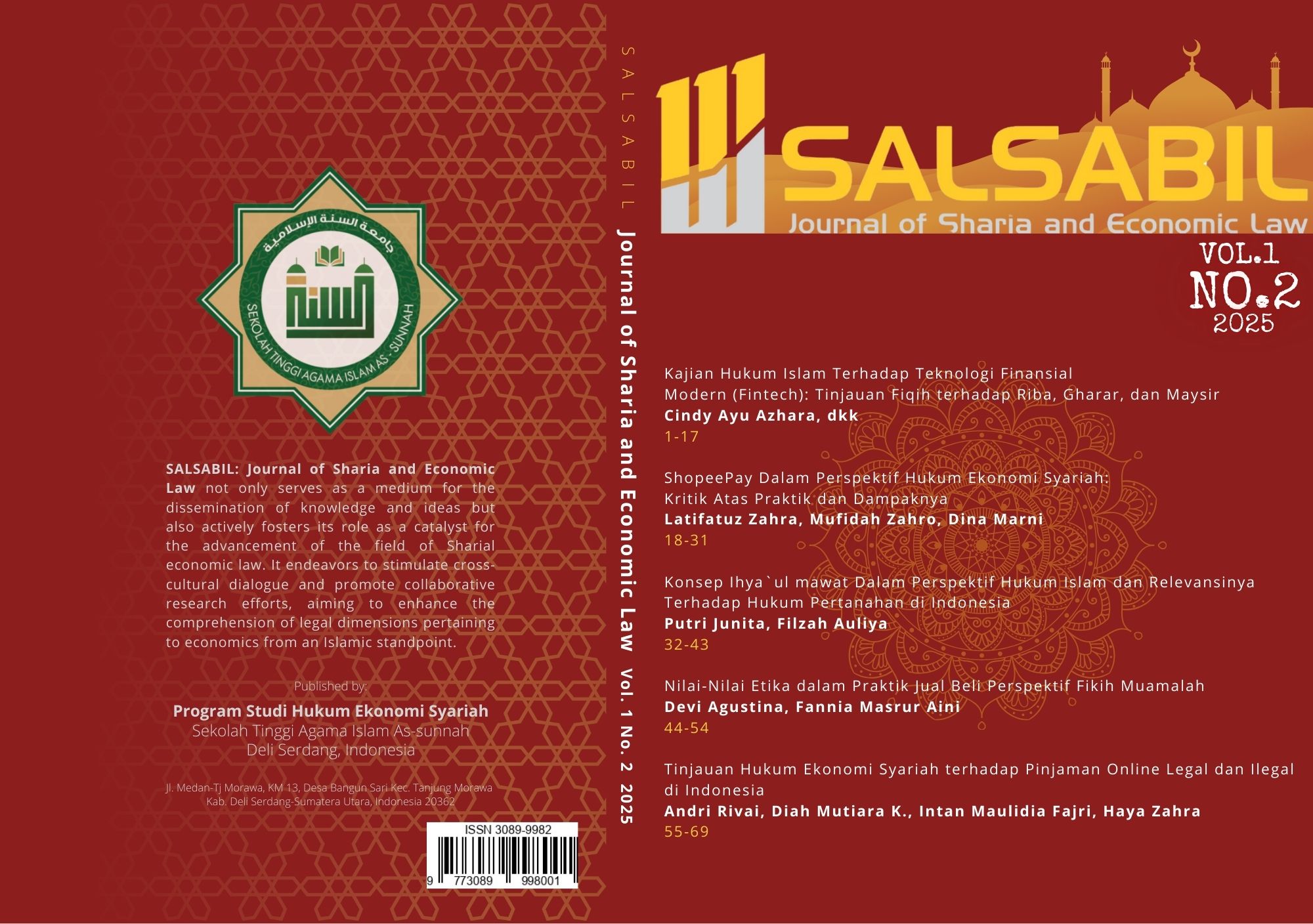
Kajian Hukum Islam Terhadap Teknologi Finansial Modern (Fintech): Tinjauan Fiqih terhadap Riba, Gharar, dan Maysir
DOI:
https://doi.org/10.51590/salsabil.v1i2.40Keywords:
Islamic fintech, Islamic law, riba, gharar, digital investment, cryptocurrencyAbstract
The development of financial technology (fintech) has provided greater ease in financial transactions for Muslim communities, yet it also raises challenges regarding compliance with Islamic principles. This study aims to explore the alignment of fintech services—such as e-wallets, online lending, digital investments, and cryptocurrencies—with Islamic law. Using a qualitative literature review approach, the research analyzes scholarly articles, fatwas, and relevant financial regulations. The findings indicate that many fintech services can be adapted to comply with Islamic law through the application of contracts such as murabahah, mudharabah, musyarakah, and qardhul hasan. Adaptive regulation and improved Islamic financial literacy are essential to ensure conformity with the objectives of Islamic law (maqashid al-shariah). The study recommends stronger collaboration among regulators, scholars, and industry stakeholders to build an inclusive and sustainable Islamic fintech ecosystem that promotes not only innovation, but also adherence to Islamic values.
References
Ardita, V. Y., & Ahmadi, M. A. (2024). Green Finance Sebagai Pendukung Keberlanjutan Ekonomi: Analisis Konsep Dan Implementasi. Culture Education and Technology Research (Cetera), 1.
Arvante, J. Z. (2022). Dampak Permasalahan Pinjaman Online dan Perlindungan Hukum Bagi Konsumen Pinjaman Online. Ikatan Penulis Mahasiswa Hukum Indonesia, Law Journal, 79.
Fitriani, & Marlina, R. (2024). TRANSAKSI PINJAMAN ONLINE DALAM PERSPEKTIF EKONOMI SYARIAH. Al-Kharaj, 3(2).
Haryanti, S. (2025, May 5). Fintech Syariah: Peluang, Tantangan, dan Strategi Pengembangan Fintech Syariah di Indonesia. Tazkia Institute.
Haryati, N. (2021). Business model analysis of mushroom agroindustry and its sustainable development strategy in Covid-19 pandemic. IOP Conference Series: Earth and Environmental Science, 733(1), 012125. https://doi.org/10.1088/1755-1315/733/1/012125
Mardani. (2012). Fiqh Ekonomi Syariah: Fiqh Muamalah. Kencana.
Martínez-Cañas, R., Ruiz-Palomino, P., Jiménez-Moreno, J. J., & Linuesa-Langreo, J. (2023a). Push versus Pull motivations in entrepreneurial intention: The mediating effect of perceived risk and opportunity recognition. European Research on Management and Business Economics, 29(2), 100214. https://doi.org/10.1016/j.iedeen.2023.100214
Martínez-Cañas, R., Ruiz-Palomino, P., Jiménez-Moreno, J. J., & Linuesa-Langreo, J. (2023b). Push versus Pull motivations in entrepreneurial intention: The mediating effect of perceived risk and opportunity recognition. European Research on Management and Business Economics, 29(2), 100214. https://doi.org/10.1016/j.iedeen.2023.100214
Mujahidin, A. (2017). Hukum Perbankan Syariah. Rajawali Pers.
Murdwiyanto, E. F. (2018). Faktor-faktor Yang Mempengaruhi Keputusan UMKM Dalam Mengambil Pinjaman Melalui Peer to Peer (P2P) Lending. Agricultural.
Muryanto, Y. T., Kharisma, D. B., & Ciptorukmi Nugraheni, A. S. (2022). Prospects and challenges of Islamic fintech in Indonesia: a legal viewpoint. International Journal of Law and Management, 64(2), 239–252. https://doi.org/10.1108/IJLMA-07-2021-0162
Noor, Lady, & Ahmadi, M. A. (2025). Pengaruh Digitalisasi, Literasi Keuangan, dan Dukungan Teknologi terhadap Kinerja Keuangan UMKM di Kabupaten Karanganyar. Pusat Publikasi Ilmu Manajemen, 3.
Parrino, R. J., & Romeo, P. J. (2012). JOBS Act eases securities‐law regulation of smaller companies. Journal of Investment Compliance, 13(3), 27–35. https://doi.org/10.1108/15285811211266083
Pattnaik, P. N., & Pandey, S. C. (2017). University startups and special legislations. International Journal of Law and Management, 59(5), 718–728. https://doi.org/10.1108/IJLMA-05-2016-0046
Rahadi, D. R. (2020). Financial Technology: It Is An Emerging Industry That Uses Technology To Improve Activities In Finance. PT. Filda Fikrindo.
Rizal, M., & others. (2018). Fintech Sebagai Salah Satu Solusi Pembiayaan Bagi UMKM. Jurnal Pemikiran Dan Penelitian Administrasi Bisnis Dan Kewirausahaan, 3.
Rochmawati, D., & Hisyam, M. A. (2023). Tinjauan Fiqih Mu’āmalah Terhadap Praktik Financial Technology (Fintech) pada Pembiayaan PT. Qazwa Mitra Hasanah. Jurnal Kaffa, 2(1).
Sugiyono. (2016). Metodelogi Penelitian Pendidikan: Pendekatan Kuantitatif, Kualitatif, dan R&D. Alfabeta.
Wiwoho, J., Kharisma, D. B., & Wardhono, D. T. K. (2021). Financial Crime In Digital Payments. Journal of Central Banking Law and Institutions, 1(1), 47–70. https://doi.org/10.21098/jcli.v1i1.7
Yu, J., Rezaee, Z., & Zhang, J. H. (2019). The accounting and market consequences of the JOBS Act of 2012: an early study. Asian Review of Accounting, 27(1), 49–68. https://doi.org/10.1108/ARA-02-2017-0033
Downloads
Published
Issue
Section
License
Copyright (c) 2025 Cindy Ayu Azhara, Nabila Zulfa Nur Latifa, Faris Fadhilah Zakiy, Much Yudi Firmansyah, Tegar Adi Nugraha, Muhammad Hakim Asshabi, Mirzam Arqy Ahmadi

This work is licensed under a Creative Commons Attribution 4.0 International License.