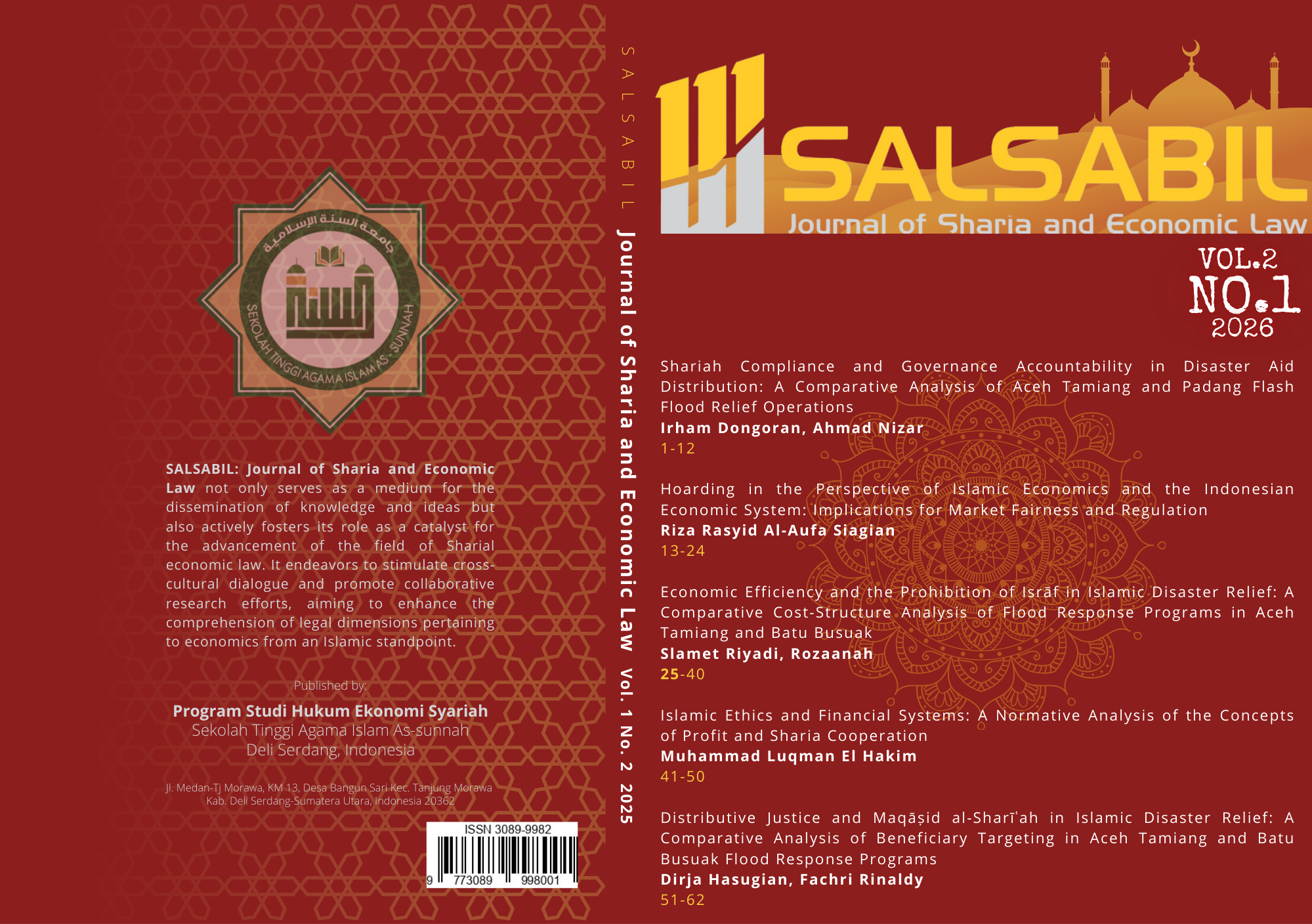
Economic Efficiency and the Prohibition of Isrāf in Islamic Disaster Relief: A Comparative Cost-Structure Analysis of Flood Response Programs in Aceh Tamiang and Batu Busuak
DOI:
https://doi.org/10.51590/salsabil.v2i1.63الكلمات المفتاحية:
isrāf، economic efficiency، Islamic public finance، humanitarian logistics، disaster relief، maqāṣid al-sharīʿah، ḥifẓ al-mālالملخص
This article examines economic efficiency in Islamic disaster relief operations through the lens of the sharīʿah prohibition against isrāf (waste/extravagance) and the maqāṣid principle of ḥifẓ al-māl (preservation of wealth). Drawing empirical evidence from two Indonesian flood response programs—the November 2025 Aceh Tamiang intervention (IDR 138,500,000 serving 270 households) and the December 2025 Batu Busuak response (IDR 57,000,000 serving 150 households)—this study conducts a comparative cost-structure analysis examining resource allocation patterns, logistical efficiency indicators, and operational decisions affecting aid delivery effectiveness. The methodology employs cost-per-beneficiary analysis, procurement strategy assessment, and distribution method evaluation against Islamic public finance principles. Findings reveal that both programs achieved comparable cost-efficiency ratios (IDR 513,000 and IDR 380,000 per household respectively), with divergent strategies for minimizing waste: the Aceh Tamiang program emphasized volunteer mobilization and multi-stakeholder coordination, while the Batu Busuak program leveraged international philanthropy networks and local procurement to reduce transportation costs. Both programs demonstrated alignment with the Islamic prohibition of isrāf through strategic resource allocation, though opportunities exist for enhanced efficiency through standardized procurement protocols and improved logistics coordination. This article contributes to Islamic economic law scholarship by operationalizing classical jurisprudential concepts of waste prohibition within contemporary humanitarian logistics frameworks, proposing sharīʿah-compliant efficiency metrics for disaster relief evaluation.
المراجع
Abd Wahab, Norazlina, and Abdul Rahim Abdul Rahman. “A Framework to Analyse the Efficiency and Governance of Zakat Institutions.” Journal of Islamic Accounting and Business Research 2, no. 1 (2011): 43–62. https://doi.org/10.1108/17590811111129508.
Al-Ghazālī, Abū Ḥāmid Muḥammad ibn Muḥammad. Iḥyāʾ ʿUlūm Al-Dīn. Vol. 4. Beirut: Dār al-Maʿrifah, n.d.
Al-Shāṭibī, Abū Isḥāq Ibrāhīm. Al-Muwāfaqāt Fī Uṣūl Al-Sharī’ah. Beirut: Dār al-Kutub al-’Ilmiyyah, 1997.
Ali, Salman Syed. Towards a Maqāṣid Al-Sharīʿah Index of Socio-Economic Development: Theory and Application. Cham: Palgrave Macmillan, 2019.
Balcik, Burcu, Benita M Beamon, Caroline C Krejci, Kyle M Muramatsu, and Magaly Ramirez. “Coordination in Humanitarian Relief Chains: Practices, Challenges and Opportunities.” International Journal of Production Economics 126, no. 1 (2010): 22–34. https://doi.org/10.1016/j.ijpe.2009.09.008.
Chandra, Dori, Taufik Hidayat, Tiy Kusmarrabbi Karo, Indra, Andri Rivai, and Ade Muhammad Ritonga. “The Collaboration of Academics, Students, and Volunteers in Responding to the Aceh Tamiang Flood Disaster: A Participatory Action Research-Based Aid Distribution Model.” Al-Arkhabiil: Jurnal Pengabdian Masyarakat 5, no. SI-1 (2025): 2–20.
Chapra, M Umer. The Future of Economics: An Islamic Perspective. Leicester: The Islamic Foundation, 2000.
Djaghballou, Chams-Eddine, Mohamed Djaghballou, Mousa Larbani, and Azhar Mohamad. “Efficiency and Productivity Performance of Zakat Funds in Algeria.” International Journal of Islamic and Middle Eastern Finance and Management 11, no. 3 (2018): 474–94. https://doi.org/10.1108/IMEFM-07-2017-0185.
Hasan, Nurdin, and Ahmad Nizar Yogatama. “Islamic Philanthropy and Social Justice: The Role of Islamic CSR in Indonesia.” Kyoto Bulletin of Islamic Area Studies 6 (2013): 85–105.
Hassan, M Kabir, and Mervyn K Lewis. Handbook on Islam and Economic Life. Cheltenham: Edward Elgar Publishing, 2015.
Holguín-Veras, José, Miguel Jaller, Luk N Van Wassenhove, Noel Pérez, and Tricia Wachtendorf. “On the Unique Features of Post-Disaster Humanitarian Logistics.” Journal of Operations Management 30, no. 7–8 (2012): 494–506. https://doi.org/10.1016/j.jom.2012.08.003.
Holguín-Veras, José, Noel Pérez, Miguel Jaller, Luk N Van Wassenhove, and Felipe Aros-Vera. “On the Appropriate Objective Function for Post-Disaster Humanitarian Logistics Models.” Journal of Operations Management 31, no. 5 (2013): 262–80. https://doi.org/10.1016/j.jom.2013.06.002.
Ibn ʿĀshūr, Muḥammad al-Ṭāhir. Maqāṣid Al-Sharīʿah Al-Islāmiyyah. Jordan: Dār al-Nafā’is, 2001.
Kamali, Mohammad Hashim. Principles of Islamic Jurisprudence. 3rd rev. ed. Cambridge: Islamic Texts Society, 2006.
Kamaruddin, Muhammad Iqmal Hisham, and Mustafa Mohd Hanefah. “An Empirical Investigation on Waqf Governance Practices in Waqf Institutions in Malaysia.” Journal of Financial Reporting and Accounting 19, no. 3 (2021): 455–73. https://doi.org/10.1108/JFRA-03-2020-0055.
Kovács, Gyöngyi, and Karen M Spens. “Humanitarian Logistics in Disaster Relief Operations.” International Journal of Physical Distribution & Logistics Management 37, no. 2 (2007): 99–114. https://doi.org/10.1108/09600030710734820.
Özdamar, Linet, and Mustafa Alp Ertem. “Models, Solutions and Enabling Technologies in Humanitarian Logistics.” European Journal of Operational Research 244, no. 1 (2015): 55–65. https://doi.org/10.1016/j.ejor.2014.11.030.
Ramdani, Ramdani, Tika Widiastuti, and Imron Mawardi. “Implementation of Islamic Values in Waqf Governance: A Systematic Literature Review.” Journal of Islamic Marketing 15, no. 8 (2024): 1925–41. https://doi.org/10.1108/JIMA-03-2023-0079.
Riyadi, Slamet, Arbonas Lubis, Fian Triadi, Dirja Hasugian, Zulham Effendi, Muhammad Syarif Muda Hasibuan, Khairul Anhar, Syahri Ramadona, and Muhajirah Binti Jamaluddin. “Humanitarian Aid for Flash Flood Victims in Batu Busuak: An International Collaboration Between STAI As-Sunnah and Bayaan Association Singapore.” Al-Arkhabiil: Jurnal Pengabdian Masyarakat 5, no. SI-1 (2025): 22–31.
Saad, Ram Al Jaffri, Aidi Ahmi, Norfaieqah Sawandi, and Noor Afza Abdul Aziz. “Zakat Administration Reformation Towards an Effective and Efficient Zakat Revenue Generation.” Journal of Islamic Accounting and Business Research 14, no. 8 (2023): 1232–60. https://doi.org/10.1108/JIABR-05-2021-0151.
Tag el-Din, Seif Ibrahim. Maqasid Foundations of Market Economics. Edinburgh: Edinburgh University Press, 2013.
Wassenhove, Luk N Van. “Humanitarian Aid Logistics: Supply Chain Management in High Gear.” Journal of the Operational Research Society 57, no. 5 (2006): 475–89. https://doi.org/10.1057/palgrave.jors.2602125.
Zobel, Christopher W, Nezih Altay, and Mark P Haselkorn. Advances in Managing Humanitarian Operations. Cham: Springer, 2016.
التنزيلات
منشور
إصدار
القسم
الرخصة
الحقوق الفكرية (c) 2026 Slamet Riyadi, Rozaanah Rozaanah

هذا العمل مرخص بموجب Creative Commons Attribution 4.0 International License.